What is an Electronic Drilling Recorder?
An Electronic Drilling Recorder (EDR) is a drilling instrumentation system that acquires, processes, and displays real-time drilling data from sensors and field devices across the rig. The EDR provides Drillers with comprehensive process monitoring via analogue and digital readouts, trend displays, alarm pages, and event logging — giving the drill floor a single, authoritative view of rig operations as they happen.
Formerly referred to as a Rig Monitoring System (RMS) or Drilling Rig Monitoring System, the EDR has evolved significantly in scope and capability. Where early systems focused primarily on surface parameter logging, today’s EDR functions as a full drilling data acquisition platform — integrating sensor inputs, third-party system interfaces, pit volume totalisation, and remote data access into a unified Driller’s interface.
RCP EDR systems are highly customisable and fully tailored to meet specific customer requirements. The complete specification is agreed between the customer and RCP during the Functional Design Specification (FDS) stage, ensuring the delivered system is configured precisely to the rig type, sensor complement, and operational requirements.

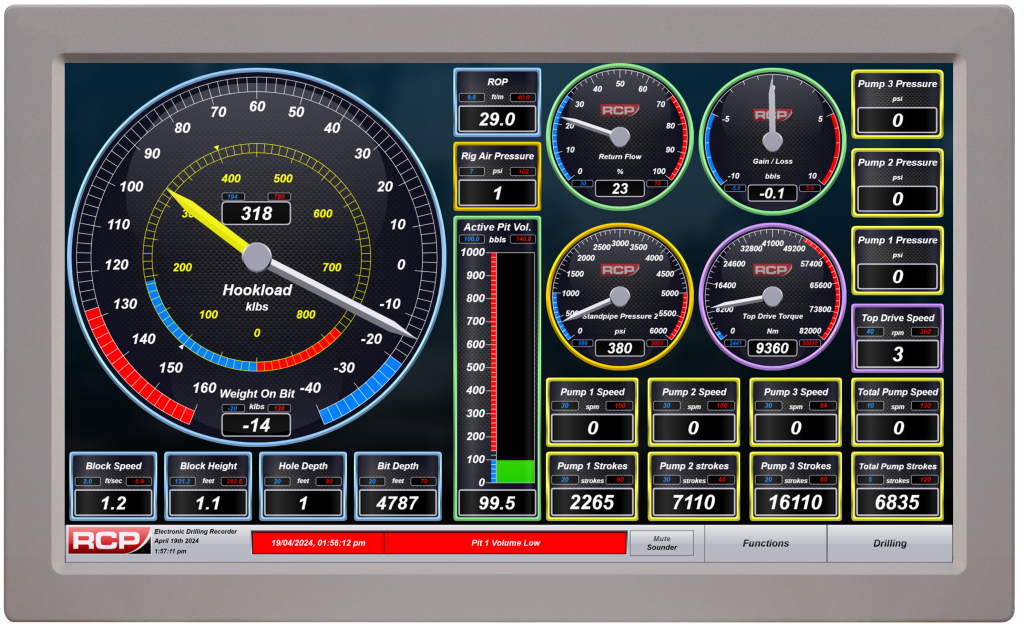
EDR Drilling Screen

EDR Tripping Screen
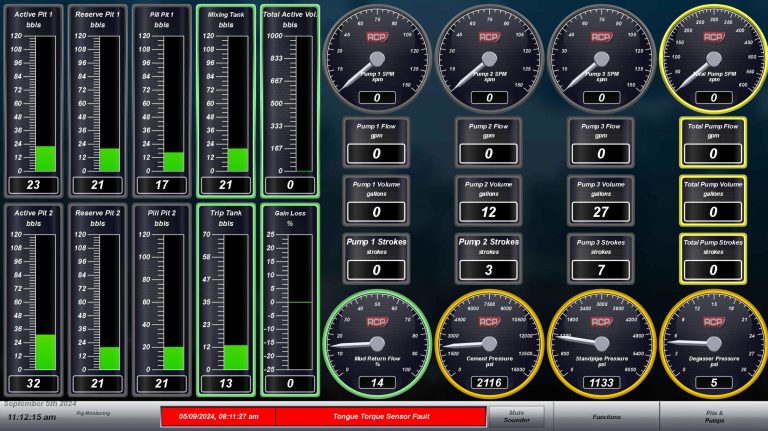
EDR Pits and Pumps Screen
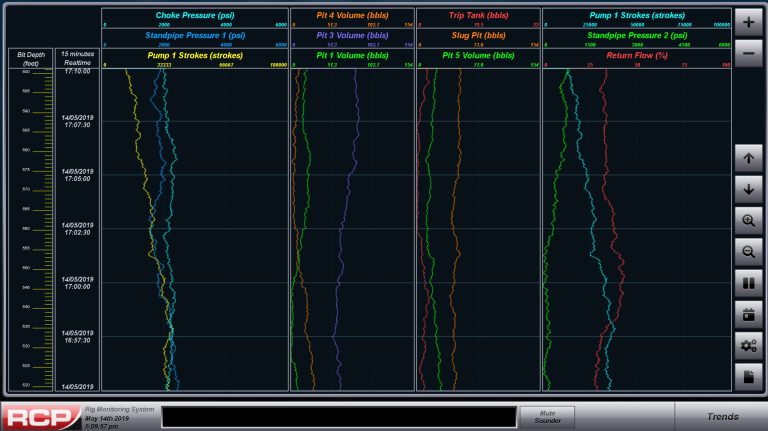
EDR Trends Screen
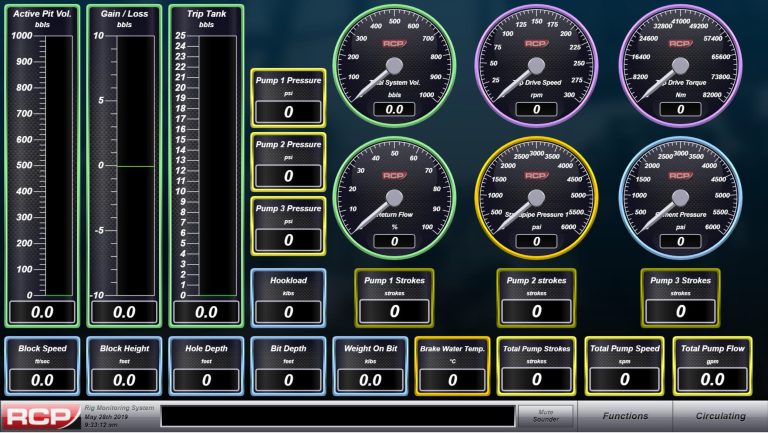
EDR Circulating Screen
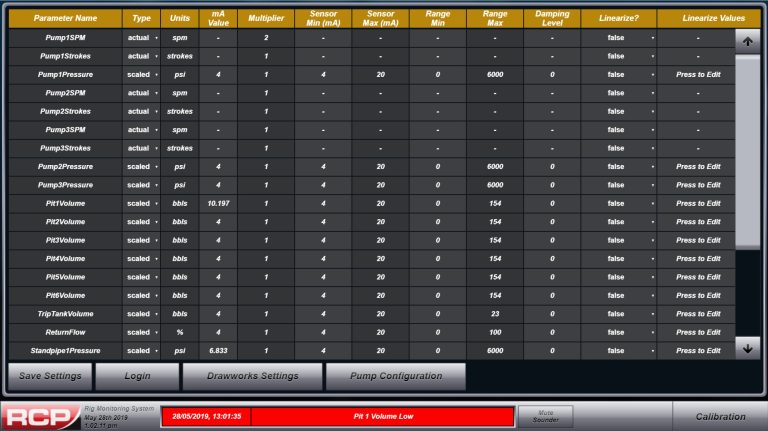
EDR Calibration Screen
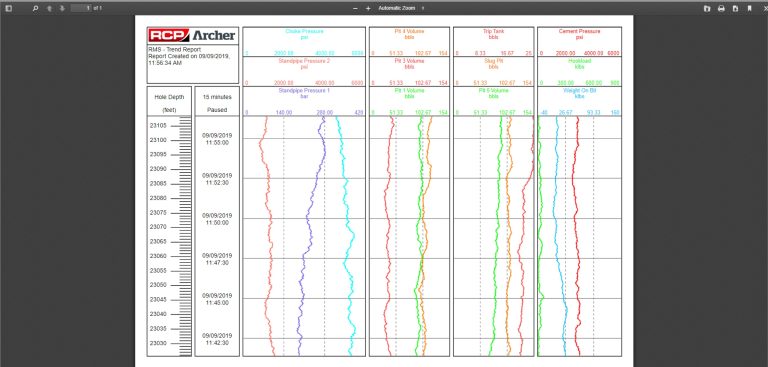
EDR User Generated Trends Report

EDR Reports Screen (User Generated Events Report)
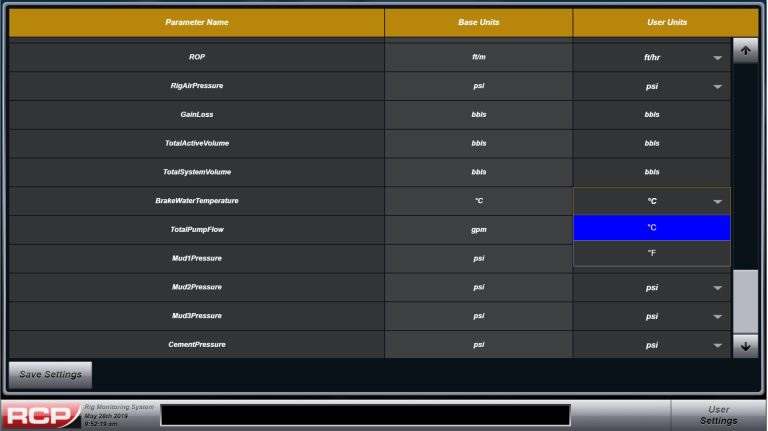
EDR User Settings Screen

EDR – Alarms Screen (red for unacknowledged, active alarms)
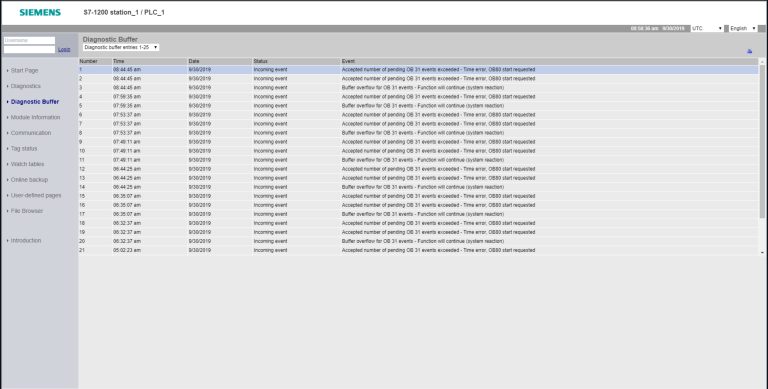
PLC Diagnostics Screen Accessible via EDR HMI

EDR Alarm Setup Screen (Alarms can be set directly by pressing on value, or via this screen)
Rig Compatibility
Drilling Data Acquisition & System Functions
At its core, the RCP EDR is a drilling data acquisition system — continuously sampling and logging process variables from the drill floor, mud system, rotary equipment, and ancillary rig systems at one-second intervals. Data is stored locally using a First In First Out (FIFO) overwrite principle, with a typical six-month retention period that is optionally expandable to two years or beyond. A Redundant Array of Independent Disks (RAID) server can be specified to extend data logging redundancy further.
The EDR interface provides Drillers with real-time and historical trend displays, configurable high and low alarms, pit volume totalisation including pump stroke totalisation, liquid seal monitoring, BOP and Diverter data display, valve position indication, and fine scale gauge display. Additional workflow tools include pipe tally, personalised screens, chat, report generation, logged data exporting, a calculator, and notes. Remote cloud access is available via a secure AWS cloud-based server.
As a process monitoring system, the EDR integrates across the full range of drilling instrumentation — from hookload and standpipe pressure through to gas detection, pit levels, pump flow, and top drive torque. The PLC operates on a <10 ms computational cycle, ensuring derived calculations including ton-miles, drilling activity hours, tripping speed, and derrick loading are updated continuously alongside measured values. Additional functions are available upon request.
Pit Volume Totalisation & Mud Monitoring
The RCP EDR includes a fully integrated pit volume totaliser (PVT) as a core system function. Pit levels are monitored via intrinsically safe radar sensors across the active mud system, with the EDR providing continuous gain/loss monitoring, selected pit totalisation, and trip tank monitoring — all displayed in real time on the Driller’s HMI.
The system supports standard pit level radar sensors (0–20 m measurement range) and high-accuracy pit level radar sensors (0–120 m range). The pump stroke and flow totalisation runs alongside pit volume data, with pump strokes, flow counts, and selected pump totalisation all logged and trended through the same interface.
Alarm setpoints for pit volume gain and loss are fully configurable by the Driller via password-protected access. High and low setpoint alarms trigger a flashing on-screen indication and activate the external intrinsically safe sounder/beacon. Alarms are latching type — they can be accepted and silenced, but will only clear once the alarming condition itself resolves.
Pit & Flow Measurement
- Standard pit level measurement accuracy +-0.2mm
- High Feature pit/trip tank level measurement accuracy +-0.1mm
- Gain / Loss monitoring
- Selected Pit Totalisation
- Pump Stroke Fotalisation
- Pump Flow Totalisation
- Configurable alarm setpoints
EDR System Only
Control system and HMIs supplied without field instrumentation — for integration with existing rig sensors.
EDR System + Sensors
Complete drilling instrumentation system including all field devices and sensors.
EDR System + Sensors + Installation Materials
Full turnkey package including all installation materials for complete rig-up.
Monitored & Reported Parameters
The EDR monitors and reports a comprehensive set of drilling process variables as both direct measured values from instrumentation and as derived calculations computed by the PLC. The full parameter set covers all principal drilling, mud system, rotary equipment, and surface infrastructure parameters required for real-time well control, performance monitoring, and post-well analysis.
Measured Values
Derived Values
Alarm Management & System Security
The EDR provides three categories of alarm: user setpoint high and low alarms, hardware alarms, and system alarms. Active alarms are indicated by a flashing on-screen display and activation of the external intrinsically safe sounder/beacon. Alarms can be accepted and silenced via the Driller’s HMI or an optional external accept push button.
All alarms are latching type — an accepted alarm can be silenced, but will only clear once the underlying condition resolves. Alarm setpoints are protected by a Drillers password.
Maintenance & Remote Access
Full system maintenance and calibration is accessible directly via the Driller’s HMI — removing the requirement for a specialist service laptop for routine maintenance tasks. Remote access is available as an option via a secure AWS cloud-based server, supporting remote diagnostics and data review without requiring personnel on-site.
System maintenance functions are protected by a separate Maintenance password, ensuring clear separation between operational and engineering access levels.
System Supply Options
The EDR is available in three supply configurations, allowing operators and contractors to select the scope that best fits their procurement model — whether integrating into an existing sensor infrastructure or taking a complete turnkey package from a single source.
Frequently Asked Questions About Electronic Drilling Recorder
Q: What is an Electronic Drilling Recorder?
a. Electronic Drilling Recorder is a drilling instrumentation data acquisition system. The EDR utilises field sensors to obtain and collate all the required drilling instrumentation data and executes required computations to obtain derived values. The data is then stored and displayed
b. The real-time and historical data is reported via localised Human Machine Interfaces (HMI), safe area displays or via remote cloud access.
c. The data is displayed via digital readout/gauge/bar charts. As well, the real-time and historical data is available in a trends format. The data can be exported in raw format or in an organised document report. Operators can set the high and low value alarms, which will enable the sounder/beacon once the limits are breached. As well, the trends screen is configurable by operators for their operational requirements.
d. The previous RCP EDR versions were known as Rig Monitoring System (RMS). The new EDR version superseded the RMS in 2024. Both the EDR and the RMS systems are fully supported by the RCP and will be supported in the foreseeable future (10+ years).
Q: What parameters does EDR capture?
a. The RCP EDR provides the typical drilling instrumentation and pit volume totalisation parameters such as: Weight on Bit, Hookload, Bit Depth, Hole Depth, Rate of Penetration, Block Height, Block Speed, Manifold Pressures, Top Drive/Rotary Table Speed & Torque, Pit Volumes, Pit Volume Totalisation, Gain/Loss, Return Flow, Pump Stroke Rates and Flow Rates, Gas Levels and many other.
b. Additionally, the RCP EDR tracks maintenance-related parameters such as Machine Running Hours, Drill Line Ton Miles, Drill Bit Hours and many more.
Q: Can EDR integrate 3rd party systems?
a. The RCP EDR can be configured to interface with 3rd party systems for both data reception and data handover. Various industry protocols are supported, including WITS0, OPC-UA, PROFINet, PROFIBus, Modbus/TCP, Serial, RS-485, CANBus, and more.
Q: What is EDR data retention and logging capability?
a. By standard RCP Electronic Data Logger – provides a 6-month basis data acquisition. Thus, the EDR has a 6-month sliding window of the historical data available at all times. The database operates first in first out overwrite principle, which means that the oldest data gets overwritten to keep the 6 month window.
b. The data retention can be extended to 2+ years via an external server. Data redundancy options are available as well.
Q: Does the EDR use proprietary hardware?
a. The RCP EDR control panels utilise up-to-date, industrial standard equipment from manufacturers such as Siemens, Pepperl and Fuchs, Wago, Schneider Electric, and ABB. Therefore, a worldwide spare part support is available, and the use of the most-up-to date hardware components ensures that the spare parts will not become obsolete for an estimated 10+ years.
b. RCP systems do use proprietary software. The PLC, HMI and Server software is RCP intellectual property. It is backed up and maintained by RCP (protected software backups are available to customers).
Q: Does the EDR include Pit Volume Totaliser?
a. Yes, the RCP Electronic Drilling Recorder provides all the functions of a standard Pit Volume Totaliser (PVT) system, in combination with additional drilling instrumentation functions.
b. For a PVT-only solution, please refer to the RCP PVT product page.
Q: Does the EDR record bit depth and hole depth?
a. Yes, RCP Electronic Drilling Recorder utilises a combination of sensors and calculations to obtain bit depth and hole depth. The values can be manually set via operators’ HMIs as well. Further parameters are listed in the EDR product page; custom parameters are available as well.
b. Extended parameters such as ROP, Drill Bit Hours, On Bottom Rotation Hours and more are available.
c. The Bit and Hole parameters can be integrated into the RCP travelling block monitor. Please refer to the RCP TBM product page.
Q: Are the EDR displays customisable?
a. The EDR trends screen is fully customisable by the operator to suit their needs. This includes the number of charts, the number of traces, reported parameters, colours, ranges, and automatic report generation.
b. Other EDR screens, such as Drilling and Tripping screens, are tailored to the requirements during the Functional Design Specification Stage.
EDR Product Information Summary
Download Electronic Drilling Recorder Product Information Sheet